




Key Takeaways
- A comprehensive 6-volume guard passing course from a 3rd-degree Rickson Gracie black belt, covering weight distribution, angles, collapsing frames, and soaking up space
- Heavy Q&A format — each concept is taught then reinforced with live Q&A sessions, making this feel like a private seminar on video
- Covers every major guard: knee shield, Z-guard, half guard, spider guard, leg lasso, De La Riva, and seated guard
- The core philosophy — using gravity and weight instead of strength — makes the system accessible to smaller and older grapplers
- Rating: 9/10
GUARD PASSING MASTERY HENRY AKINS DVD FULL DOWNLOAD
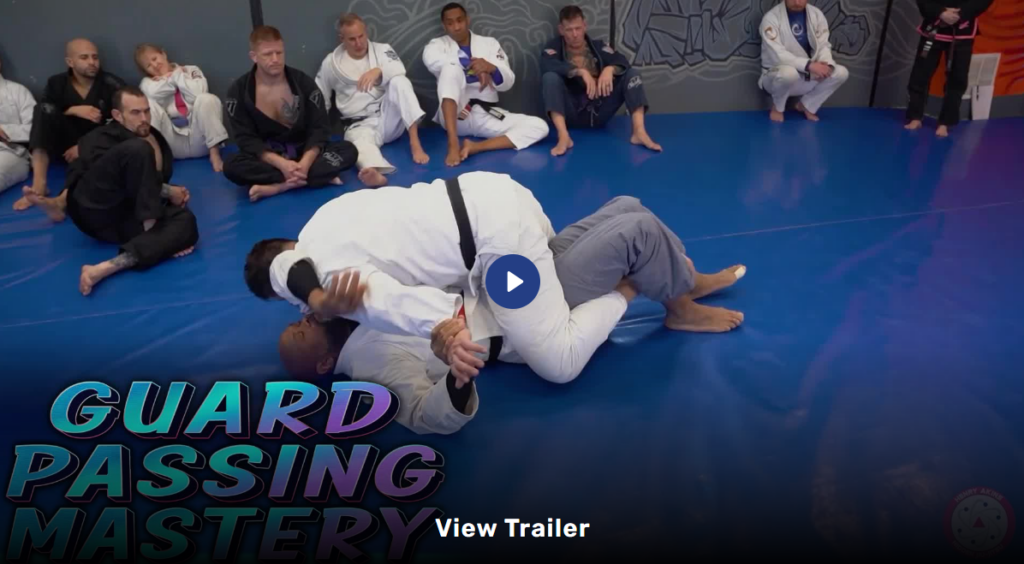
Henry Akins is one of the most respected gatekeepers of Rickson Gracie’s Jiu-Jitsu lineage. As a 3rd degree black belt under Rickson and one of the first Americans promoted to that rank, Akins has spent decades distilling the Gracie approach into a teachable system.
The Guard Passing Mastery Henry Akins DVD represents the culmination of that work — a gaurd passing Henry Akins instructional that treats guard passing as a physics problem rather than a strength contest. This review covers why the Henry Akins guard passing approach — built on weight distribution, angle management, and frame collapse — is one of the most methodical passing systems available.
The Principles of Passing That Beat Any Technique
Guard passing instructionals typically fall into two camps: technique collections that show dozens of passes without connecting them, and philosophy-driven systems that teach principles over moves. Akins’ Guard Passing Mastery falls squarely in the second camp, and it pushes the principles approach further than most.
The foundational idea is that guard passing is a confrontation of leverage systems. The bottom player builds frames — arms, legs, knee shields — to create space and prevent weight transfer. The top player must collapse those frames without overcommitting. Akins teaches that the solution is not explosive speed or athletic pressure, but precise weight distribution and angle manipulation.
The collapsing knee shield BJJ approach teaches how gravity and weight distribution guard pass mechanics work together. Apply weight in the right direction, shift to the correct angle, and the opponent’s frames collapse under their own structural weakness.

The instructional’s unique feature is its extensive Q&A format. After each concept demonstration, Akins answers student questions in real time. This Rickson Gracie black belt passing approach to teaching is rare for a BJJ instructional and adds enormous depth — the Q&A sections address the questions that come up during live drilling: what if the opponent does this, what if you are smaller, what if the angle is slightly different.
For a principles-based system where execution depends on feel (a core Hidden Jiu-Jitsu passing concept), the Q&A format is arguably more valuable than the technique demonstrations themselves.
Rickon’s First American Black Belt – Henry Akins
Henry Akins is a 3rd degree Brazilian Jiu-Jitsu black belt under the legendary Rickson Gracie, and one of only three Americans originally promoted to black belt by Rickson. He began training in 1995 at Rickson’s academy in Los Angeles, quickly becoming one of Rickson’s most intuitive students. By 1997 he was assisting the head instructor, and by 2000 he was teaching classes directly for Rickson.
In 2004, Rickson promoted Akins to black belt and entrusted him to run the Gracie academy in Los Angeles — a role he held until 2008 when a severe back injury forced him to step back. During this time, Rickson also selected Akins to teach his son Kron, a testament to the trust Rickson placed in Akins’ understanding of the system.
After recovering, Akins co-founded Dynamix MMA in Santa Monica in 2010 with K-1 and UFC legend Anthony Hardonk. The academy has become one of the premier training centers in Southern California. Akins also created Hidden Jiu-Jitsu, an online platform dedicated to teaching the fundamental principles of Rickson’s system, and Mind Blown Jiu-Jitsu, a members-only group where he answers training questions directly.
Akins stands 6’1″ and weighs 210 pounds. Outside of Jiu-Jitsu, he is known for his friendship with Maynard James Keenan (lead singer of Tool) — the two became training partners, and Akins worked as Keenan’s personal bodyguard during world tours.
Guard Passing Mastery Henry Akins DVD Review
This Henry Akins guard passing course goes deeper into the Rickson Gracie black belt passing methodology than any other instructional on the market. The collapsing knee shield BJJ material and weight distribution guard pass concepts are worth the price alone. It is the best path to genuine understanding of how guard passing works for the Hidden Jiu-Jitsu audience.
Volume 1: Weight Distribution, Angles, Concepts
The first volume establishes the philosophical foundation of the entire system. Akins begins with the concept of weight distribution and angles — not as abstract principles, but as measurable mechanical choices. He explains how shifting your weight to different quadrants of the opponent’s body changes their ability to frame, and how angle changes can turn an impenetrable guard into an open path.
The gravity-focused approach to getting closer is a standout. Akins teaches how to use your own body weight to sink closer to the opponent rather than reaching or lunging — a counterintuitive method that conserves energy and maintains pressure.
The knee shield collapse drills teach the two primary passing directions: to the front and to the back. Akins then moves into specific guards — the spider guard, the leg lasso, and De La Riva — demonstrating how the same weight and angle principles apply regardless of the guard structure. The Q&A sessions after each section address practical concerns: how to maintain pressure without exhausting yourself, what to do when the opponent frames on your neck, and how to prevent guard recovery.
Volume 2: Shifting Angles and Soaking Up Space
Volume 2 deepens the concepts with more detail on angle shifting and space management. The “soaking up space” concept — the idea of absorbing the opponent’s frames by shifting your weight into them rather than pushing against them — is central to Akins’ method.
The knee shield sections are the most detailed. Akins teaches three approaches: collapsing the knee shield with weight, going around the knee shield, and using the head to control the shoulder when passing to the back. Each approach receives its own Q&A treatment, addressing the specific failure points.
The Z-guard section is particularly valuable. Akins shows how to deal with the shin across the hip — a position that frustrates many passers — by adjusting your angle and using your weight to drive the opponent flat before passing.
Volume 3: Collapsing Frames and Knee Cuts
Part 3 covers frame collapse — arguably the most practical skill in the entire system. Akins demonstrates how to collapse the frame created when the opponent places a forearm against your neck, a common defensive structure that stops most passers cold.
The knee cut from the collapsing position is a highlight. Akins shows how switching angles while soaking up space creates the opening for the knee cut, and how to prevent guard recovery after the cut is complete. The two options for passing half guard with the knee shield — one going to the front and one going to the back — provide a complete toolkit for the most common guard retention position.
The sumo squat approach to dealing with a seated opponent is a novel addition. Rather than engaging in hand fighting or explosive passing entries, Akins teaches a wide base, heavy pressure approach that forces the opponent to carry your weight.
Volume 4: Half Guard Knee Shield
In the fourth volume, which is the shortest volume, Akins covers more critical ground. The hook sweep defense is essential — one of the most common reactions to a heavy passing attack is the hook sweep, and Akins shows how to anticipate and counter it.
The knee bar from half guard is an unexpected but welcome addition. While this instructional focuses on passing, Akins shows how attacking the kneebar can force the opponent to open their guard, creating a passing opportunity. The collapsing frames section reinforces the concepts from Volume 3 with additional drilling and troubleshooting.
Volume 5: Seated & Half Guard
Volume 5 opens with concept and strategy for attacking the seated guard. Akins argues against excessive hand fighting — a counterintuitive point from a Rickson lineage instructor — explaining that hand fighting wastes energy and gives the opponent reaction time. Instead, he teaches using the arms to redirect the opponent’s legs.
The wrestling-up counter is critical. When the opponent tries to stand in base and wrestle up, Akins shows how to use head position and weight distribution to shut down the escape. The half guard sections cover the underhook battle, freeing the trapped leg, transitioning to mount, and using the knee slice to reach cross side.
The section on the difference between being on your toes versus flat-footed during passing is the kind of detail that makes this instructional special. Most instructionals assume you know when to be on your toes, but Akins explains why it matters: being on your toes changes your center of gravity and your ability to shift angles.
Volume 6: Advanced Concepts & Drills
The final volume covers edge cases and advanced applications. Akins addresses the specific concerns of smaller and lighter grapplers — how to apply the same weight distribution principles when you physically outweigh nobody.
The frame collapse on the knee shield receives its most detailed treatment, including what happens when the frame shifts to different angles. The shin-across-the-hip section addresses different shin angles and sweep counters, solving one of the most frustrating guard retention problems.
The sleeve control section — passing when the opponent has sleeves and feet on your hips — addresses the classic spider guard problem. Akins demonstrates how clearing the foot on the hip requires relaxation and angle work, not explosive movement. The De La Riva and spider guard sections in this volume provide additional options when the opponent’s guard retention is particularly strong.
The ultimate drill closes the series — a progressive drilling format that develops all the skills from the previous five volumes into a single flowing practice. This drill alone is worth revisiting regularly as a maintenance practice for the entire passing system.
Learning Principle-Based Jiu-Jitsu
The six-volume structure and Q&A format mean this instructional demands time. Unlike a technique collection that can be consumed in a single sitting, Guard Passing Mastery requires active engagement — watching a section, drilling it, then returning to the Q&A for troubleshooting.
The most efficient approach is to work through the volumes in order, focusing on one guard type per session. Start with the knee shield since it is the most common guard retention position. Once the knee shield collapse is comfortable, move to spider guard and leg lasso, then De La Riva.
The Q&A sections are best treated as review material. Watch the technique demonstration first, try it on the mats, then come back to the Q&A for answers to the questions that emerged during drilling. This mirrors the seminar experience that Akins has created.
The system works for both Gi and No-Gi. The weight distribution and angle principles are universal — they do not depend on grips. The spider guard and leg lasso sections apply more to Gi, but the knee shield, half guard, and seated guard sections transfer directly to No-Gi.
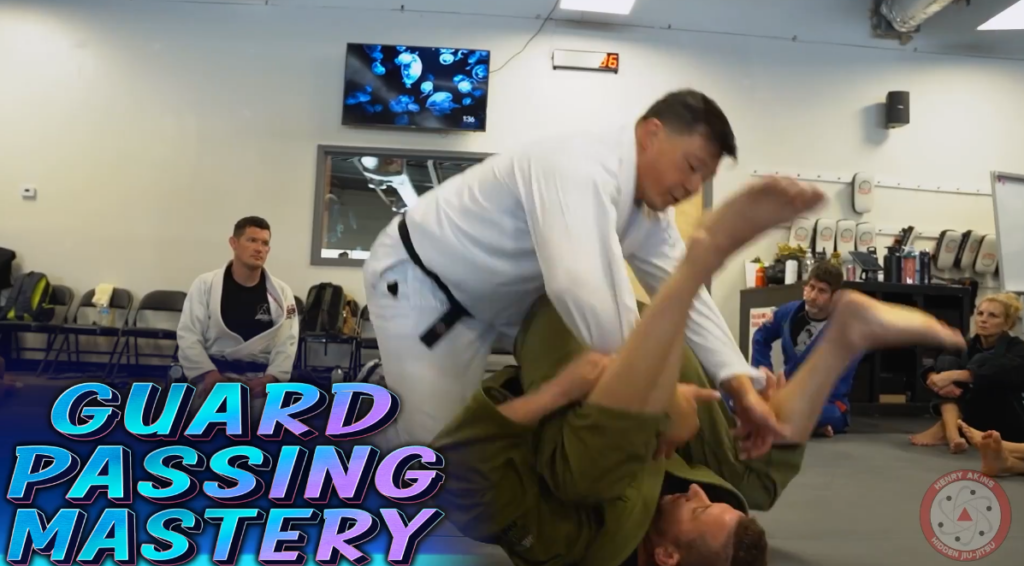
GET IT HERE: GUARD PASSING MASTERY HENRY AKINS DVD
Who Is This For?
This instructional is ideal for intermediate grapplers (blue belt and above) who have a basic passing game and want to develop a principles-based approach that works regardless of the guard they face. Small and older grapplers will benefit enormously — the emphasis on weight distribution, gravity, and efficiency over athleticism is designed for practitioners who cannot rely on speed and strength.
Competitors will find the system invaluable for developing a passing game that does not depend on specific entries. When you understand how to collapse frames and shift angles, you can pass any guard — even ones you have not seen before.
Coaches will appreciate the Q&A format as a teaching blueprint. The questions Akins receives from students are the same questions that come up in any academy setting, and his answers provide a framework for explaining passing concepts to students.
Beginners may find the volume count overwhelming and the concepts abstract. The instructional assumes you understand guard retention positions (knee shield, Z-guard, De La Riva). White belts who are still learning guard retention should work through the fundamentals first.
Pros & Potential Drawbacks
Pros
- Genuinely principles-based: The weight distribution and angle approach is a complete system, not a collection of techniques — it teaches you how to solve guard passing problems, not just replicate specific passes
- Q&A format adds real value: The student questions and Akins’ answers cover the practical problems that come up during drilling, which is rare in video instructionals
- Science of frame collapse is excellent: The detail on how to collapse frames — not just the knee shield but also arm frames and forearm-on-neck defenses — is among the best available
- Accessible to smaller grapplers: The emphasis on gravity and efficiency over strength means this system works for anyone willing to learn the mechanics
- Covers all major guards: Knee shield, Z-guard, spider guard, leg lasso, De La Riva, half guard, seated guard — nothing is left out
Potential Drawbacks
- High price point: At $279, this is one of the more expensive guard passing instructionals. The depth and Q&A format justify the cost, but casual practitioners may hesitate
- Pacing can be slow: The Q&A format, while valuable, slows the pace significantly. This is a study course, not a highlight reel
- Heavy Gi emphasis: The spider guard, leg lasso, and De La Riva sections are Gi-specific. No-Gi practitioners will get value from Volumes 1-3 and Volume 5 but may skip portions of the other volumes
Master Passing
The Guard Passing Mastery Henry Akins DVD is a rare instructional — one that teaches a complete thinking system rather than a bag of tricks. The weight distribution and frame collapse approach, combined with the unique Q&A format, creates a learning experience that mirrors private instruction. At 9/10, this is a premier instructional for the grappler who wants to pass with precision rather than power.