








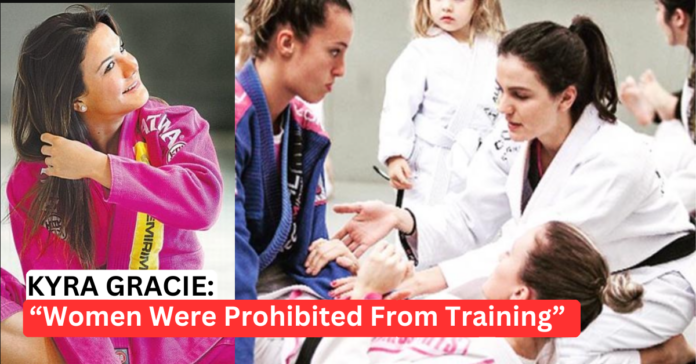

- ADCC champion Kyra Gracie has reignited an uncomfortable conversation in Jiu-Jitsu by describing what she calls Gracie family sexism, including women being discouraged — and even “prohibited” — from training.
- Kyra Gracie on Gracie family sexism: becoming a champion was the only way to “have a voice” in a family culture where the winner got status, attention, and authority.
- Kyra also claims women’s achievements were treated as “cool” while men’s wins were treated as “wow,” pointing to a massive prize-money gap as part of the problem.
- In a separate recent podcast appearance, she broadened the critique to Jiu-Jitsu culture at large, arguing that “competition-only” gyms historically pushed out women and non-competitive students.
Kyra Gracie is one of the most decorated women ever to represent the most famous surname in Jiu-Jitsu — and she’s using that platform to say the quiet part out loud.
In multiple recent interviews and appearances, Kyra Gracie on Gracie family sexism didn’t come packaged as a vague “things were different back then” comment.
It landed like an elbow from mount: direct, blunt, and personal. She described a culture where women weren’t simply overlooked — they were actively discouraged from stepping on the mat, and in her mother’s case, she says the family outright stopped her from training.
That’s a loaded claim in any sport. In Jiu-Jitsu — a community that still treats “Gracie” like a holy word — it’s gasoline.
Kyra Gracie on Gracie Family Sexism and the “Champion Gets A Voice” Rule
Kyra framed the family dynamic in a way every competitor instantly understands: status goes to the winner.

“The best spot on the couch back home was for the champion. Who chose the food? The champion. If there was any debate in the family about anything, the champion had the final word.”
– Kyra Gracie –
That mindset, she says, shaped her entire pathway into the sport — not just as an athlete chasing medals, but as a young woman trying to earn the right to be heard in her own environment.
“I said, ‘Well, I guess I’ll have to become a champion to have a voice here too. I’ll follow these footsteps.’”
– Kyra Gracie –
That’s the hook that makes this story travel: she isn’t selling a “girl power” slogan. She’s describing a system where winning wasn’t optional — it was the entry fee for legitimacy.
And when your last name is Gracie, “legitimacy” is the currency.

Prohibited From Training
The most jarring part of Kyra Gracie on Gracie family sexism isn’t even about her — it’s about her mother.
In recounting her family’s attitudes toward women training, Kyra says her mother made it to blue belt before being told to stop.
“She got to blue belt and then had to stop. She was prohibited from training by my uncles because that wasn’t the ideal path for a woman.”
– Kyra Gracie –
That detail matters because it undercuts the sanitized version of Jiu-Jitsu history that fans often repeat: the idea that the art was always “for everyone,” and the culture just naturally evolved.
Kyra’s version is much uglier: women didn’t slowly trickle in because they “weren’t interested.” They were kept out — socially, structurally, and sometimes directly — and the people doing it weren’t random gym bros. They were family.
Gracie Family Sexism, Pay Gaps, and The “Cool Vs. Wow” Problem
Kyra doesn’t just describe exclusion — she describes how women’s success was treated once they broke through.
“Women weren’t valued within the family. First they are prohibited [from training], and then if you win, it’s like: ‘Cool.’ But if a man wins: ‘Wow, that’s awesome… The great champion.’”
– Kyra Gracie –
That “cool vs wow” line is painfully familiar to a lot of women in Jiu-Jitsu: the sense that you can be exceptional, dominant, disciplined — and still get treated like a novelty side story.
Kyra also pointed to financial reality as a reinforcement mechanism, claiming men could earn far more than women for championship wins at the time.
Whether or not every number holds up across every event, the broader point lands: when the money, prestige, and marketing tilt heavily to one side, the culture follows.
And it’s not just prize checks. Kyra described being undervalued as an instructor, saying she heard variations of, “You’re a woman, so we’ll charge less,” and “not many people will attend.”
That’s not ancient history. That’s a reminder that some of the sport’s “old-school” assumptions still show up in the business side of Jiu-Jitsu — seminar pricing, headliner slots, poster placement, and who gets treated as a draw.
Building A Different Jiu-Jitsu
If Kyra Gracie on Gracie family sexism was the headline, her broader critique might be the bigger fight: she’s also arguing that Jiu-Jitsu drifted away from being a confidence-building tool and toward being a survival test designed mainly for tough, competitive people.
In a recent podcast discussion, she described an academy culture where the intensity wasn’t just hard — it was designed to break people.
She recalled an environment where “Friday was the day of beatings,” and argued that this “strong-only” model historically pushed out exactly the people who could benefit most: women, smaller students, and non-competitive adults who came for self-confidence, fitness, or personal development.
Her response hasn’t been a social-media rant. It’s been building a different structure — including separating classes by goals and student profiles, not just belt level.
In that model, competitors get their room, but the “executive,” the beginner, and the person chasing lifestyle training doesn’t get thrown into the deep end and told to drown or adapt.
This part is important because it turns the story from pure controversy into a power move: Kyra isn’t just criticizing. She’s positioning herself as someone trying to reshape what “real Jiu-Jitsu” even means.
“Friday Was The Day Of Beatings”
This is why the story spreads: it’s not just about the past, and it’s not just about one famous family.
Kyra Gracie on Gracie family sexism forces the community to look at two uncomfortable truths at the same time:
Jiu-Jitsu’s growth story isn’t as clean as people want it to be — especially for women.
The same dynamics still echo today, just in different forms: who gets promoted as “the face,” who is treated as legitimate, who gets paid, and who gets brushed off with a polite “cool.”
The Gracie name built an empire on the idea that Jiu-Jitsu makes you stronger — physically and mentally. Kyra’s critique is that for women, the sport often demanded extra strength just to be allowed in the room.
And that’s why this doesn’t die in a comment section. Because if the most famous “Jiu-Jitsu royal family” had to be dragged — internally — into accepting women on the mat, it raises a brutal question for everyone else:
If your gym culture is still dismissing women, still treating them like a side category, still “protecting” them instead of empowering them… how much of that is tradition — and how much is just sexism with a Gi on?