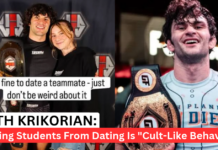






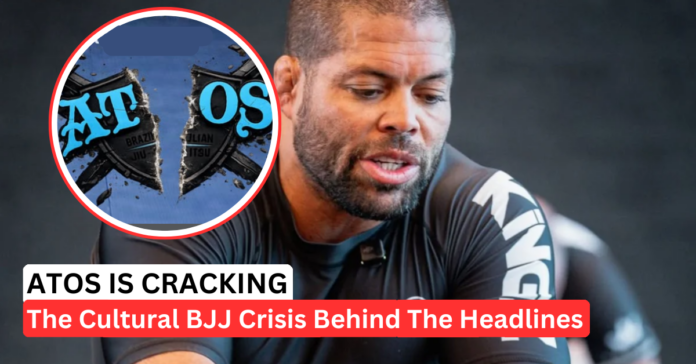

- A wave of public accusations of sexual misconduct involving Andre Galvão detonated inside one of the most successful teams in modern Jiu-Jitsu.
- High-profile athletes, gym owners, and affiliates began cutting ties aftrer the Atos scandal—some before allegations went public, many more immediately after.
- Atos leadership announced an immediate, indefinite separation of Andre and Angelica Galvão from all roles, plus a third-party investigation.
- The BJJ community split into two loud camps: “protect students and rebuild the sport” vs. “presume innocence and wait for courts.”
- The Downfall of Atos Jiu-Jitsu now isn’t just about one team—it’s a stress test for the entire culture of hierarchy, loyalty, and “coach-as-hero.”
Atos didn’t become a powerhouse by accident. It became a blueprint—an academy network that turned medals into marketing, champions into recruiting tools, and team identity into something closer to a passport. For years, the flag meant excellence: world titles, ADCC credibility, and a reputation for producing killers across Gi and No-Gi.
Then, almost overnight, the flag became radioactive.
The Downfall of Atos Jiu-Jitsu is still unfolding in real time, but the outlines are already brutal: allegations against a legendary figurehead; an internal culture accused of enabling silence; an exodus of elite names; sponsors stepping back; affiliates ripping logos off walls; and a headquarters forced to publicly separate its most recognizable leaders while promising an outside investigation.
This is an exposé not because it revels in drama—but because the scale of the collapse demands the uncomfortable question: Was this inevitable in a sport built on unequal power relationships, hero worship, and private-room accountability?
From Dream Team To Brand Empire
Atos Jiu-Jitsu was founded in 2008 by Andre Galvão and Ramon Lemos, with roots that quickly grew into an international network. Its main headquarters became synonymous with San Diego, but the team expanded through affiliates across multiple countries—an ecosystem that blended competition success with a franchise-like identity structure.
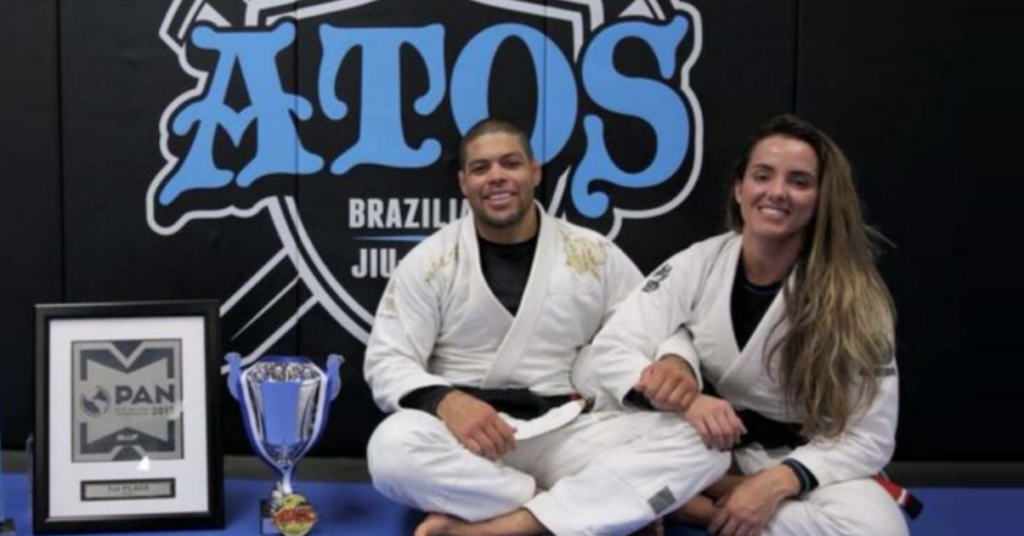
The motto—“Together We Are Stronger”—wasn’t just a slogan. It was the pitch.
In practical terms, Atos became a pipeline: kids programs feeding juvenile and adult teams; full-time competitors training beside hobbyists; visitors flying in for “the room”; and a steady stream of tournament results reinforcing the idea that Atos wasn’t merely a team—it was the standard.
The coaching tree mattered too. Ramon Lemos has long been credited as a major developer of elite talent (including world-class names across eras and weight classes), and Atos’ competitive footprint expanded alongside a culture of “proving it on the mat.” The result was a team identity so strong that many students didn’t just train at Atos—they grew up inside it.

That’s why the Downfall of Atos Jiu-Jitsu hits differently than your average affiliation breakup. This isn’t a gym closing. This is a tribe fracturing.
The Atos Jiu-Jitsu Allegations: Timeline Of A Collapse
The public crisis accelerated when Alexa Herse—a young athlete who had trained within Atos from childhood—released a statement accusing Andre Galvão of sexual misconduct. In that statement, she described incidents she said made her feel uncomfortable during training sessions. She also said she filed a police report and urged others to come forward.
Silence only protects abusers, and I refuse to be silent anymore.
– Alexa Herse –
Her allegations landed like a grenade because of who she is in the Atos universe: not a random visitor, not a one-off student, but someone connected to the team’s internal story—someone who framed Galvão as a coach she once viewed as a hero and father figure.
And the details mattered. The accusation wasn’t a vague “bad vibes” complaint. It described specific behaviors—touching she said was inappropriate, comments about her body and appearance, and incidents during training that she characterized as sexual in nature.
Even before that statement, multiple established figures had reportedly begun distancing themselves from the team—suggesting internal conversations were already happening. In other words: the public didn’t start the fire. The public just saw the smoke.
Herse also claimed that when she tried to raise concerns internally, Angelica Galvão (Andre’s wife and a coach) discouraged her from speaking out, framing it in terms of loyalty and protection of the team. That allegation—of a “circle the wagons” response—became gasoline, because it mirrored a pattern many in martial arts recognize: the student is vulnerable; the coach has status; the team has incentives to protect the brand.
From there, the story broadened fast. The conversation moved beyond one statement into a wider theme: the way Jiu-Jitsu hierarchy can turn a gym into a closed system where the person with the most authority is also the least accountable.
At a major event in the UK, Adele Fornarino—fresh off a high-profile win—spoke directly to that theme, describing what she framed as a structural problem in Jiu-Jitsu.
There’s a big, big problem and it’s coming from the hierarchal structure of our sport.
– Adele Fornarino
That line landed because it didn’t sound like gossip. It sounded like an indictment of the sport’s operating system.
Meanwhile, mainstream and tabloid-style coverage amplified the “coach accused / student quits team” framing—pulling the story further outside the hardcore grappling bubble and into the broader sports internet. For Atos, that matters. Because a team can survive internal drama. Surviving public brand contamination is a different animal.
The Exodus: JT Torres, Josh Hinger, Sponsors and Affiliates Walk Away
Once the accusations became public, the departures stopped looking like isolated choices and started looking like a coordinated evacuation.
Lucas Pinheiro—an accomplished Atos competitor—announced he was cutting ties after speaking with multiple people he trusted inside the team and after his wife reportedly spoke with Herse. Bruno Frazzatto, one of the original Atos core members, was also among the early figures to break away—reportedly renaming his gym and removing the affiliation.
Then came one of the loudest signals possible: JT Torres.
Torres announced that Essential Jiu-Jitsu would end its affiliation with Atos, stating that his academy and affiliates would operate independently going forward.
As a coach and leader, providing and maintaining a safe environment is not optional.
– JT Torres –
That sentence is the nightmare scenario for any team in crisis—because it reframes the story from “allegations vs. denials” into “students’ safety vs. brand loyalty.” It also tells every parent reading between the lines: If a coach like JT is walking away, what does he know—or what does he believe is credible enough to act on?
Josh Hinger’s statement hit from a different angle—less institutional, more emotional. He described heartbreak, anger, and disgust at how he viewed the situation being handled, and he made his support for Herse explicit.
It’s nauseating to see how these disgusting situations have been handled.
– Josh Hinger –
Hinger also said he had severed remaining ties with Atos and Andre Galvão. That matters for two reasons:
It signals this isn’t just “internet outrage.” These are people with deep history and real relationships.
It shows how a crisis becomes contagious. The moment one respected figure speaks, others feel pressure to clarify where they stand.
The commercial dominoes fell too. Kingz Kimonos—long associated with Atos—suspended its sponsorship of both the team and Galvão. In combat sports, sponsorship isn’t charity. It’s brand math. When sponsors step back, it often means the risk profile has changed faster than the team can contain.
Atos affiliates followed. High-profile academies—Atos Miami, Atos United Kingdom, and a large portion of Australian affiliates—were reported as departing. Other U.S.-based schools removed Atos branding quietly, which is arguably more telling than a dramatic announcement: it suggests owners wanted distance without becoming part of the headline cycle.
At this point, the Downfall of Atos Jiu-Jitsu stopped being a scandal and became a logistical reality. Students had to decide where to train. Coaches had to decide whether the logo on their wall was worth the reputational price. And competitors had to decide whether the Atos name on their records now helped them—or followed them like a shadow.
The Split At Headquarters and the Fight Over the Narrative
As the fallout intensified, Atos headquarters released a statement announcing that Andre Galvão and Angelica Galvão had been immediately and indefinitely separated from all roles within the organization. The statement also said a third-party investigation was underway.
That’s the kind of move teams make when they believe the damage has passed the “PR problem” stage and entered the “survival” stage.
But the HQ decision also created a new battle: the fight over what this actually means.
Is it a genuine attempt to protect students and rebuild trust?
Is it a legal strategy?
Is it an internal power shift designed to keep the broader Atos network alive while sacrificing (or suspending) the faces most closely associated with the brand?
At the same time, there’s another truth that complicates the conversation: multiple reports stressed that no criminal verdict had been reached at the time of writing, and at least one outlet emphasized that no legal charges had been confirmed by authoritative public sources yet. That distinction matters—both ethically and legally—and it’s why the story has become a perfect storm.
Because in the middle of “no verdict” and “third-party investigation” sits a huge real-world problem: gym culture is not a courtroom. Students and parents don’t need a conviction to decide they feel unsafe. Gym owners don’t need a verdict to decide they can’t risk their reputation. Sponsors don’t need a judge to decide the logo is too expensive.
That’s why the reactions became polarized.
On one side: people calling for accountability, reform, and safety-first policies—especially around minors, coach-student boundaries, and power imbalance. On the other side: people insisting on presumption of innocence and warning against mob justice.
Jonathas “Ratinho” Eliaquim became one of the rare prominent Atos figures to publicly defend Galvão, framing his stance around loyalty and belief in the family.
I will stand by the Galvão family and not turn my back on them.
– Jonathas “Ratinho” Eliaquim –
That stance—rare, but loud—highlights what this crisis exposes: teams aren’t just training groups. They’re social systems. And when a social system breaks, people don’t react like neutral observers. They react like family members who feel threatened, betrayed, protective, angry, or all of the above.
This is where the narrative war becomes dangerous. Because in the worst cases, “team loyalty” can become a tool that pressures victims into silence or pressures witnesses into denial. But “instant condemnation” can also become a tool that destroys reputations without due process.
The sport is stuck in that tension—and the Downfall of Atos Jiu-Jitsu is forcing everyone to pick a side, even if the most responsible answer is: protect students now, and let legal facts develop without hysteria.
After The Downfall of Atos Jiu-Jitsu, BJJ Has Nowhere Left To Hide
Here’s the part nobody likes: Atos isn’t a one-off anomaly. It’s just the biggest example of a problem Jiu-Jitsu has struggled to confront for years—because the sport is built on intimacy and authority.
You train inches from someone’s body. You trust your coach with your safety. You accept hierarchy as part of learning. You’re told loyalty is a virtue. And if you’re a kid—or a young competitor raised inside a team—your coach isn’t just your instructor. They can become your entire social world.
That’s why the “hero worship” theme keeps resurfacing. Ryan Hall, writing about cultish behaviors and the failure of communities to police themselves, warned that internet noise isn’t enough.
Scorn and snarky comments on Internet forums are not enough—they fade away.
– Ryan Hall –
That line reads like a prophecy now—because this moment demands more than outrage. It demands systems.
If the sport wants to learn anything from the Downfall of Atos Jiu-Jitsu, it’s this: medals can’t be the only measure of legitimacy. Teams need standards that protect students even when the coach is famous, even when the gym is winning, even when the brand is booming.
What could that look like?
- Clear safeguarding policies for minors (including boundaries for private training, travel, and coach-athlete communication).
- Transparent reporting pathways that don’t route complaints back into the same hierarchy that benefits from silence.
- Independent oversight options—even if informal at first—so students aren’t forced to “prove” their experience to the very people invested in denying it.
- Affiliate accountability, where the logo means you accept baseline standards—not just revenue-sharing and brand alignment.
- A cultural shift where leaving a team after raising concerns isn’t treated as betrayal.
And what about Atos itself?
The brand might survive as a fragmented network. Some academies may rebrand. Some may keep the name. Some may rebuild trust locally even if the global reputation is scorched. But “together we are stronger” only works when people believe “together” doesn’t mean “silent.”
For now, the only honest ending is uncertainty. Allegations are allegations until proven in court—but training environments are real life, and real life demands immediate safety decisions.
Atos helped define modern competitive Jiu-Jitsu. The tragedy is that the Downfall of Atos Jiu-Jitsu might define what comes next even more.