










- A BJJ harassment study of women training in Brazil reports that 61.6% experienced harassment connected to their Jiu-Jitsu environment.
- The same research cites earlier survey data showing teammates and instructors were the most commonly reported sources.
- Researchers argue the issue is often normalized or minimized inside martial arts culture, making it harder to report.
- For academies, the question is no longer “does it happen?” — it’s whether there are clear policies, reporting options, and consequences.
The 61.6% Number That Won’t Go Away
Brazilian Jiu-Jitsu runs on trust. People agree to simulated violence — chokes, joint locks, pins — because everyone is supposed to respect boundaries and stop on the tap. That’s what makes the art addictive. It’s also what makes harassment especially corrosive when it shows up in the same room.
A recent BJJ harassment study surveying 193 female practitioners across Brazil reported that 61.6% had experienced harassment during training. The figure is blunt, and that’s the point: it turns a “maybe” into a measurable pattern.
If the majority of women have dealt with harassment at some point, then “we’ve never had an issue” starts to sound less like reassurance and more like a lack of visibility.
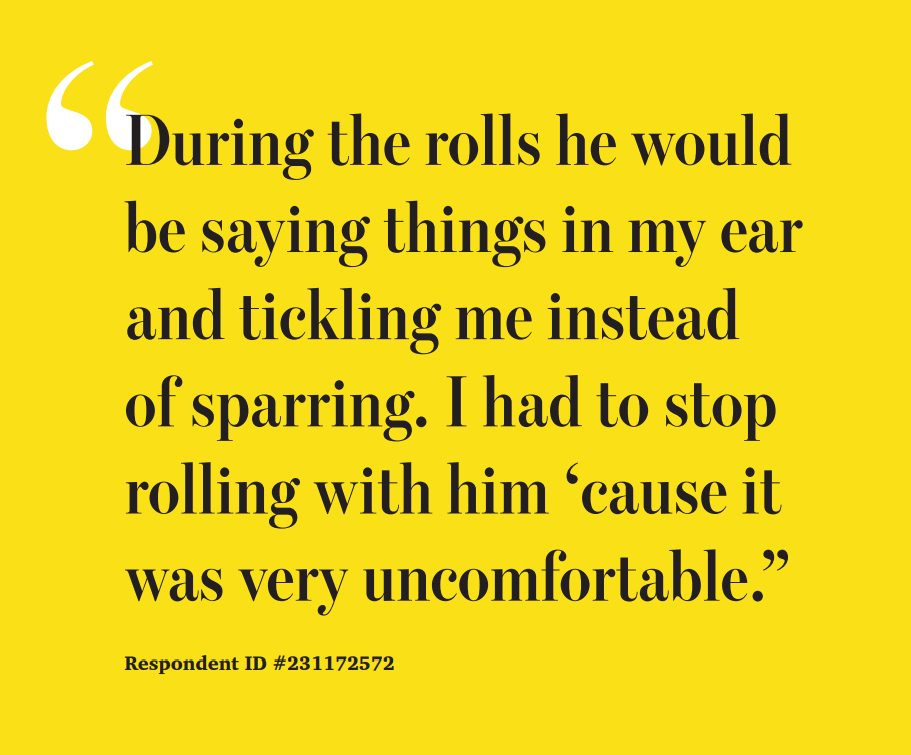
Training Partners And Instructors Show Up In The Data
The study describes harassment across moral, verbal, and sexual categories, tying it to “machismo” inside the training environment. But the detail that hits hardest is who the research points toward — because it’s not a faceless outsider problem.

Within the paper, the authors reference an earlier survey of 259 Brazilian women that reported the same 61.6% harassment rate and broke down where it came from. In that survey, 50.4% identified training partners as the source, while 34.1% identified instructors. Nearly half (48.4%) said they knew someone close to them who had also been harassed.
That combination matters. Training partners are the day-to-day contact, and instructors are the authority. When those two groups are where most complaints cluster, it helps explain why so many incidents never get handled openly — speaking up can threaten a person’s ability to train at all.
“Our investigation reveals a prevalence of gendered harassment in martial arts… and a tendency to minimize the possibility of harassment being fostered in training spaces.”
– Harassment of Women Martial Artists (peer-reviewed paper) –
Why Grappling Culture Makes Misconduct Easier To Minimize
A big theme in the BJJ harassment study is normalization: sexist jokes treated as “locker room talk,” women’s ability underestimated, and boundary-crossing behavior reframed as awkward flirting or a misunderstanding.

Add the coach–student hierarchy and reporting can feel like stepping into a social minefield — especially for newer students who don’t want to be labeled “dramatic” or “difficult.”
That pattern isn’t limited to Jiu-Jitsu. Broader research on harassment in women martial artists describes the same cultural reflex: to individualize harassment as someone’s ego problem, rather than recognize how training spaces can quietly enable it.
When a gym’s only “policy” is vibes, the safest choice for many women becomes the quiet exit — switching class times, changing academies, or just disappearing.
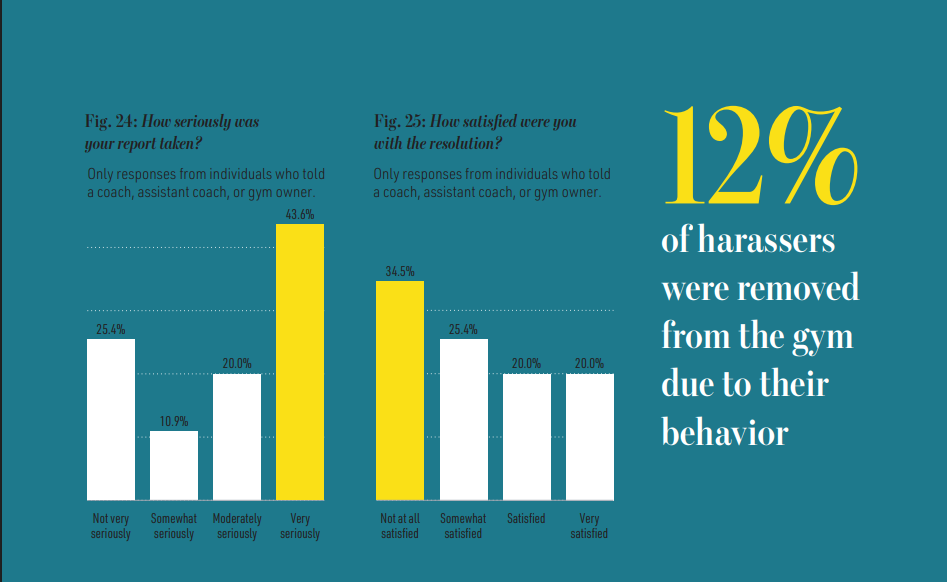
“Victims changed class times or gyms twice as often as harassers were removed from the gym.”
– Shut Up & Train report –
What “Women-Friendly” Looks Like In Real Life
The most valuable use of this BJJ harassment study isn’t outrage — it’s prevention. The fixes that actually help are practical and boring, which is exactly why they work.
Start with clarity: a written code of conduct that spells out boundaries and consequences, not just “be respectful.”
Then build reporting options that don’t funnel everything back to the same hierarchy. If the problem can involve instructors, academies need an alternate contact and a process that protects privacy early on.
Next, make consent a coaching habit. Ask before hands-on adjustments. Be explicit about what contact is necessary for the technique. Treat “no” as complete — no explanations required. And for private lessons and minors, remove ambiguity with written rules on one-on-one sessions, communication, and supervision.
Finally, teammates have to matter. In the survey data referenced by the study, training partners were the most commonly identified source.
That’s also a reminder that training partners can be the fastest line of defense — calling out “small” behavior early is easier than dealing with escalation later.
The New Standard For A “Good Academy”
A gym doesn’t prove it’s safe by saying the right things online. It proves it by what happens when a boundary gets crossed: people know how to report, they believe they’ll be taken seriously, and there are real consequences.
The 61.6% harassment figure is uncomfortable, but it’s also actionable. If Brazilian Jiu-Jitsu wants to keep growing — and keep women on the mats — the sport can’t rely on silence as its safety plan.