





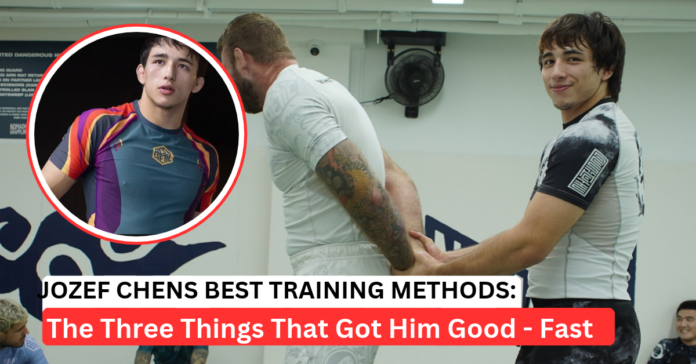

- At 22, Jozef Chen has built one of the fastest rises in modern grappling after starting Jiu-Jitsu at 14.
- Three Jozef Chen habits get all the credit: recording his rounds, talking to partners afterward, and reflecting deliberately.
- The habits sit on top of a training system built around growth versus performance — ideas drawn from Josh Waitzkin’s “The Art of Learning.”
- His path was self-directed from the start, with a coach who pushed him to research on his own and test new ideas.
At 22, Jozef Chen has built one of the more remarkable rises in modern grappling, having begun training Brazilian Jiu-Jitsu at just 14. The speed of that ascent invites an obvious question: what actually drove it?
When Chen broke it down recently, the answer was not a new submission or a sharper guard pass. It was three Jozef Chen habits, none of which involve learning a single technique.
The Three Jozef Chen Habits Behind His Rise
The first habit is deceptively simple: record your training sessions. Chen argues that memory is selective, especially mid-round when the heart rate is up and focus is split. Footage removes the guesswork.
I think this really does a great job of making it so that you’re able to actually see what’s happening, as opposed to only just trying to remember what happened. You get a recording of what happened so you can actually see, okay, this was the problem, that was the problem, and then you can try to find ways to solve it.
– Jozef Chen –
The second habit is social: talk to your training partner after the round. The person across from you felt your pressure, saw the openings you left and noticed things you never registered. A short conversation surfaces information that lives nowhere else.
There are a lot of things that you might not necessarily notice that your partner may be trying to do, or they might have noticed on you. So I think having a good conversation with your partner post-round a lot of times can be very useful, especially if they’re doing something that’s giving you a lot of trouble.
– Jozef Chen –
The third habit is the most demanding: deliberate reflection. Instead of finishing a round and moving on, Chen runs through a set of pointed questions — what happened, where the problems were, whether they keep repeating, and how he might solve them.

He is open that the answers are not always right, but insists the recall process itself is what drives progress. When he learns something genuinely new, he writes it down on his phone so he can articulate and organise the idea rather than losing it.
Any type of reflection I think is very important, because that kind of attempt to recall what happened can make things a lot clearer than they may be. If you just engage in a round and you spar and you just leave it be, a lot of times there’s going to be a lot of things that you’re going to miss.
– Jozef Chen –
The System Underneath: Growth Vs Performance
Those three habits do not float in isolation. They sit on top of a structured training philosophy that separates sessions into two modes. Performance work sharpens his best techniques under pressure; growth work is where he experiments, attacks weaknesses and tries new ideas without worrying about the result.
The framing is borrowed from Josh Waitzkin’s “The Art of Learning,” and it points to two more ideas Chen applies directly. One is making smaller circles — refining the micro-details of a move he already owns, like grip placement, weight distribution and timing, rather than endlessly adding new techniques.

The other is investing in loss: deliberately letting partners reach their best positions and working out of them, treating short-term failure as the price of long-term completeness.
A Self-Directed Path From Age 14
None of this is accidental. Chen has described an early training environment in China that pushed him to own his development. His coach encouraged him to seek out information himself rather than relying solely on the instructor, then bring what he found back to discuss with the team.
My coach at the time encouraged me to seek out information by myself. Not only just relying on him, but also I was in a position where I could research and figure out new things, but then bring it back and discuss with my coach and teammates.
–Jozef Chen –
That permission to explore shaped how he consumed material. He did not binge entire instructionals in one sitting.
He screen-recorded short clips and watched three-minute videos before training to prime his focus, then tested new techniques against less experienced partners first — recognising that trying an unfamiliar move on an elite opponent usually means failing before the technique has a chance to develop.
Why These Three Jozef Chen Habits Stick
The appeal of these habits is that they cost nothing but attention. A phone camera, a two-minute conversation, and a note-taking app are available to every grappler in every gym, at any belt level. What separates Chen is not the tools but the consistency with which he uses them.
His own summary of the approach is blunt: “Be proactive in your learning, find the right training environment, and never stop working.” For a sport that often measures commitment in mat hours, Chen’s rise is a reminder that the grapplers who improve fastest are usually the ones doing something specific with those hours — not just logging them.