








- The BJJ apparel brand charity claims controversy around BRAUS has turned into one of the most uncomfortable stories in grappling this week, with public questions focused on charity reporting, marketing language, and whether the money trail is clear enough.
- At the center of the dispute is a simple mismatch: BRAUS still says every purchase contributes to its foundation, while the public records being cited in the criticism do not present an obvious, easy-to-follow link between product sales and charitable income.
- The story got even bigger after the critic behind the post said he was asked to sign an NDA and then received material marked “Private and Confidential” instead of shareable third-party proof.
- BRAUS Foundation’s public wording has also shifted, from stronger claims about every dollar reaching projects to broader language about a global charitable structure and group-wide support.
- No public evidence currently proves fraud. But the BJJ apparel brand charity claims backlash is now a major trust story, and that alone is damaging.
The BJJ apparel brand charity claims storm now hanging over BRAUS is not just another social media flare-up. It is the kind of story that lands hard in Jiu-Jitsu because it hits a nerve the sport takes personally: community trust.
BRAUS did not build its identity only on rash guards, Gis, and athlete sponsorships. It also leaned into a mission-driven image, repeatedly tying its brand to charity work and impact.
That is exactly why this one has legs. When a company wraps itself in good-cause branding, the standard changes. People stop asking whether the gear looks good and start asking whether the numbers make sense.
In this case, the criticism has spread because the questions are not complicated. They are basic: where did the money go, how was it recorded, and why is it so hard to show the paperwork cleanly?
The BRAUS Claim
BRAUS has publicly told customers that “Every purchase made at BRAUS contributes to the BRAUS Foundation,” and its sustainability page still frames the foundation as a major part of the company’s identity. That same page currently promotes big impact numbers, including 427 projects completed, more than 90,000 people aided, and work across five countries.
Those are not small claims. They are central branding claims.
That is why the backlash was always going to blow up once someone started comparing the public-facing message with the public-facing records. The criticism was not built around gossip or anonymous locker-room whispers.
It was built around visible marketing language, visible charity-register information, and the argument that the most important questions should be answerable quickly if the record-keeping is solid.

Evidence you can’t share isn’t evidence. Evidence that you’ve written yourself isn’t evidence.
– Benjamin Marks –
That line is brutal, and it is also why this story broke out of a niche corner of social media and into the wider grappling feed.
It distilled the whole dispute into one ugly headline-sized idea: if the charity case is strong, why does the proof seem so hard to share in a way the public can actually verify?
The Paperwork Problem Behind The BJJ Apparel Brand Charity Claims
The most damaging part of the BJJ apparel brand charity claims dispute is not the tone. It is the paperwork issue. Public ACNC register entries tied to BRAUS Foundation show “Revenue from providing goods or services” at $0 on the 2023 and 2024 Annual Information Statements surfaced in the register, while the same ACNC documents page also shows the Financial Report 2025 as overdue.
On its own, that does not prove misconduct. But it does create the exact kind of gap that invites scrutiny when a brand is telling buyers that every purchase contributes.
If product sales are part of the charitable engine, people expect the public trail to look straightforward. Right now, the public-facing trail does not look straightforward at all.
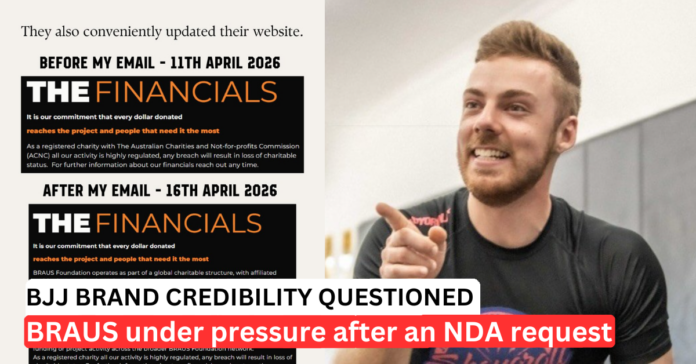
The story gets even messier because older BRAUS Foundation language was more absolute. On its About page, the foundation previously said it was committed to ensuring every dollar donated reached the people and projects that needed it most, while also telling visitors annual reporting would be available in the future.
That older wording sits awkwardly beside the newer explanation that the foundation operates across a broader multi-country structure and that one entity’s disclosures do not tell the whole story.
The NDA Request Made Everything Look Worse
If the numbers started the fire, the NDA angle poured gasoline on it. According to the reporting and the screenshots described in the dispute, the critic behind the post says he was first offered a video call, then told information could be shared after signing a non-disclosure agreement, and later sent a response marked “Private and Confidential.”
That is a terrible look in a community controversy. Maybe there are innocent explanations for parts of it. Maybe there are legal or privacy reasons behind how the foundation chose to communicate.
But in practical terms, asking for an NDA before answering basic public-interest questions about a charity-linked sales claim is almost guaranteed to make people assume the worst.
BRAUS Foundation’s own written position, as reported publicly, did little to cool the temperature. Its response said it believed it had acted appropriately and in good faith and did not propose to provide any further substantive response beyond what had already been set out.
That may be a final legal position. It is not a convincing public-relations one.
In the circumstances, BRAUS Foundation considers that it has responded appropriately and in good faith, and does not propose to provide any further substantive response beyond what has already been set out.
– BRAUS Foundation< –/h5>
Why This Is Bigger Than One Brand
The BJJ apparel brand charity claims saga matters because Jiu-Jitsu brands do not sell only products. They sell belonging. They sell values. They sell the idea that supporting them means supporting something bigger than yourself.
Once that emotional layer is part of the pitch, transparency is no longer optional window dressing. It becomes part of the product.
That is also why the response post promising a donation to charity: water for every share, up to $5,000 on May 1, 2026, landed so hard. It reframed the whole controversy as a transparency comparison.
One side was being accused of hiding behind confidential material; the other side was openly saying the community deserves receipts.
At best this is a charity that accepted donations and didn’t keep basic records. At worst it’s something more serious. Either way, the BJJ community deserves better.
– Benjamin Marks –
The BJJ apparel brand charity claims story is not going away quickly because the cleanest way to end it is also the simplest: show the documents in a way normal people can verify. Not branding copy. Not mission statements. Not internal summaries. Just clear, third-party-checkable proof that matches the public promises.