




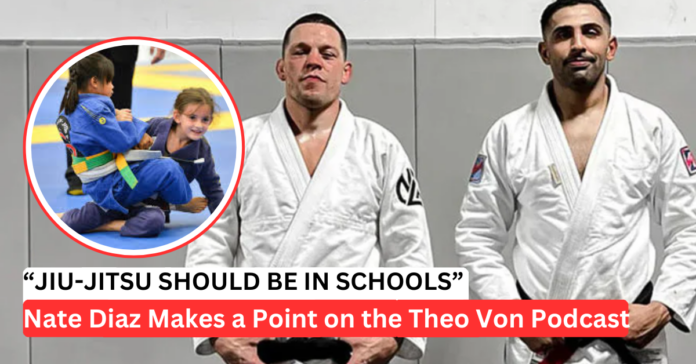

- Nate Diaz argued that Jiu-Jitsu should be taught in schools, not just for fighting, but for awareness, stability, and self-defense.
- His comments came during a recent appearance alongside Theo Von and Chris Avila.
- Diaz compared learning Jiu-Jitsu to learning how to swim, framing it as a basic life skill rather than a niche combat hobby.
- The idea lands harder because Diaz tied it to real-world confidence, social development, and even better law enforcement preparedness.
- With Nate Diaz set to fight Mike Perry next month, the clip is giving him a fresh headline outside the usual fight-promo cycle.
Nate Diaz on Jiu-Jitsu in schools is the kind of quote that instantly grabs grapplers, fight fans, and anyone who thinks martial arts talk usually drifts into cliché. This one did not.
Diaz was direct, almost dismissively simple about it: people should learn how to defend themselves, schools are the obvious place to start, and society would probably be better off if more people had even a little real experience with physical conflict.
That is what makes the clip pop. Diaz was not pitching Jiu-Jitsu as some magical cure-all, and he was not dressing it up in polished self-help language either. He framed it the way he usually frames everything: bluntly, practically, and with a little edge.
In his view, too many people walk around with a false sense of confidence and no real clue what happens when things get physical. That gap, to him, is not just naive. It is dangerous.
I think jiu-jitsu should be.
– Nate Diaz –
Why Nate Diaz On Jiu-Jitsu In Schools Is Resonating Beyond MMA
Plenty of fighters have praised martial arts before, but Diaz’s version hits differently because he stripped the argument down to basics. He did not talk about medals, belt promotions, discipline posters, or inspirational slogans.

He talked about awareness. He talked about people being “a little more stable walking around.” He talked about the idea that even limited training changes how a person sees risk, conflict, and their own limitations.
That is where the quote stops being just another fighter soundbite. Diaz is essentially arguing that Jiu-Jitsu should sit closer to practical life education than extracurricular sport.
Not everybody becomes a swimmer, but almost everybody agrees learning how to survive in water is useful. He placed grappling in that same category.
Jiu-jitsu, I think is necessary for everybody. It’s like learning how to swim. Like, I think everybody should learn how to swim. What if you fall in some water?
– Nate Diaz –
There is also a sharper layer to what he said. Diaz was not only promoting self-defense. He was calling out the illusion of self-defense. That is a very Diaz way of making the point, but it is also why the clip spread so quickly.
A lot of people say they could handle themselves. Much fewer people have ever actually trained enough to test that belief.
What Theo Von And Chris Avila Pulled Out Of Him
The setting matters. Diaz made the comments in a loose conversation, sitting with Theo Von and Chris Avila, which helped the whole thing feel less rehearsed and more revealing.
He was not reading from a promotional script. He was following the thread where it led, and that let the strongest part of the argument come out naturally.
When the conversation touched on law enforcement, Diaz took the idea even further. His point was not that training should begin when someone joins the police. His point was that by then it is already late.
If people had been exposed to Jiu-Jitsu in school, they would arrive at adulthood with a more realistic understanding of force, control, and what they do not know.
That is a big reason this topic has legs. Diaz was talking about a cultural shift, not a PE class gimmick. In his mind, early exposure would create more awareness across the board, from ordinary civilians to people in positions of authority.
But if they did it in school, then by the time they get to law enforcement, they would know.
– Nate Diaz –
Diaz’s Own Story
What saves this from sounding like empty fight-world posturing is that Diaz has been making versions of this point for a while.
He has spoken before about Jiu-Jitsu giving him direction when he was young, keeping him busy, and putting him on a track that eventually defined his life.
Diaz started training at 11 under Cesar Gracie, stayed tied to that team identity throughout his career, and has repeatedly credited the mats with shaping more than just his fighting style.
That background matters because Diaz did not present Jiu-Jitsu as something that merely made him dangerous. He has described it as something that made him more social, more connected, and more grounded.
That part is easy to overlook because the public image of Nate Diaz is all scar tissue, Stockton swagger, and middle fingers in big-fight moments. But underneath that image is a guy who keeps circling back to the same point: training gave him structure.
I learned how to talk to people and understand people and communicate. So it helps with just falling into the social pipeline.
– Nate Diaz –
That is probably the most interesting part of the whole story. Diaz is not just saying kids should learn takedowns and chokes. He is saying the environment around training teaches people how to relate, how to calm down, how to compete, and how to understand themselves better.
“Learn To Swim”
Nate Diaz on Jiu-Jitsu in schools is not a policy blueprint. It is not a detailed curriculum proposal. It is a much simpler and much more combustible idea than that: people would be safer, smarter, and more honest with themselves if they learned a little grappling early.
That is exactly why it will keep getting traction. Some people will hear “fighting in schools” and instantly recoil. Others will hear “self-defense, confidence, awareness, and control” and think it makes obvious sense. Diaz probably does not care much which side finds his wording too rough. He said what he meant.
It feels like one of those arguments the grappling world will keep dragging back into public conversation every few months, especially every time another athlete, coach, teacher, or parent realizes the same uncomfortable truth Diaz was pointing at: most people are a lot less prepared than they think.