







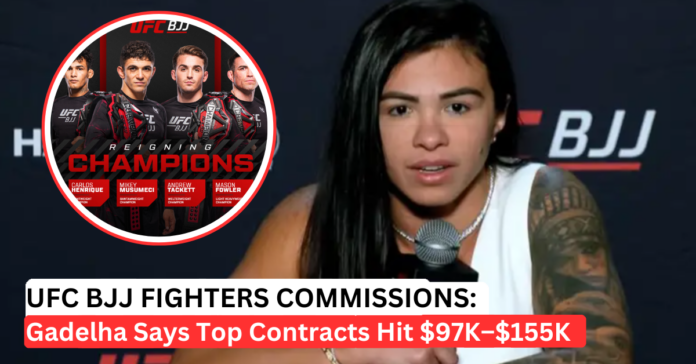

- Claudia Gadelha says top exclusive contracts are landing in the 500,000 to 800,000 Brazilian reais range annually—roughly $97,000 to $155,000 USD—if athletes hit four appearances and finish by submission.
- The UFC BJJ fighter pay structure matters: UFC BJJ’s “submission money” concept effectively rewards finishes far more than decisions, shaping how athletes fight and how they plan careers.
- The same push for “professionalization” that’s raising purses is also tightening the ecosystem—UFC BJJ exclusives are expected to be locked out of ADCC after 2026.
- Meanwhile, the money conversation is spilling into everything else: instructionals, brand-building, and even the celebrity side of the sport.
For years, elite Jiu-Jitsu athletes have lived on a weird mix of medals, clout, seminars, and “hope this superfight pays.” Now Claudia Gadelha is publicly putting real numbers on what the UFC-backed grappling project can pay—numbers that instantly change the conversation about what a “career” in Jiu-Jitsu even looks like.
On a recent podcast appearance, Gadelha described a top-end range for exclusive athletes that—if accurate—would be a seismic shift from the sport’s usual hustle-economy. It’s also the kind of claim that creates a new problem: once the pay is real, the contracts get real too.
And that’s the story hiding inside the headline. UFC BJJ Fighter pay isn’t just about bigger checks—it’s about control, scheduling, exclusivity, and what fighters will trade to get those numbers.
UFC BJJ Fighter pay: The Numbers Gadelha Put On The Table
Gadelha’s headline figure is blunt: exclusive athletes, competing four times a year, are earning between 500,000 and 800,000 Brazilian reais annually, which was translated as roughly $97,000 to $155,000 USD at the time of the discussion.
Now there are athletes earning 500,000 reais to do a jiu-jitsu contest. It’s incredible.
– Claudia Gadelha –
In a sport where “purse disclosure” usually means a vague rumor and a handshake, that kind of transparency is rare. And it immediately reframes the usual question athletes get asked—“Why aren’t you doing more superfights?”—into something more strategic: “Why would you fight anywhere else?”

But the fine print matters. The same breakdown tied those bigger annual totals to a very specific assumption: four matches per year and all won by submission, because that’s where the payout spikes.
That’s a big deal, because it suggests the pay isn’t just “a salary.” It’s an incentive structure that’s designed to shape performance.
The “Submission Money” Twist That Changes How Athletes Compete
The most interesting part of this pay conversation isn’t the top number—it’s how you get there.

UFC’s model in MMA has long been described as “show + win.” What’s being described here is closer to “show + submission,” meaning the finish is the multiplier. If you’re an athlete who can reliably submit elite opposition, you’re not just winning—you’re cashing in.
If you’re a grinder who wins on points, you might still win the match and lose the payday ceiling.
That dynamic changes athlete behavior in a way the sport hasn’t really had to confront at scale. In most grappling promotions, the incentives are scattered: win money here, a bonus there, and the real payday being the instructional you sell after the highlight clip goes viral.
With UFC BJJ Fighter pay now being framed as a structured, repeatable annual earning path, the sport gets pulled closer to a league model—one where fighters optimize careers around a calendar, not just around “who’s offering a superfight this month.”
That’s good news for athletes who’ve been trying to make a living off pure competition. It’s also how you end up with contracts that start looking less like “opportunities” and more like “commitments.”
The Catch: Bigger Purses Usually Come With Tighter Control
If the money is real, the leverage becomes real too. And Gadelha has been direct about what the promotion wants from its exclusive athletes once the next cycle hits.
In the discussion about cross-promotion and ADCC participation, she described a future where exclusivity actually means exclusivity—after a final window.
There are some of our exclusive athletes that we’ve given the ADCC to this year, but from next year on, they can only be an athlete of the UFC BJJ.
– Claudia Gadelha –
That’s the trade-off laid out plainly: if you want the stability and the payouts, you may be giving up the most legacy-rich stage in No-Gi grappling.
Gadelha also framed the broader intent as building a consistent pro pathway—more events, more regular opportunities, more structure.
We don’t want to compete with anyone. We believe in what ADCC is doing, what IBJJF is doing, we believe that these are different products from what we have and what we are doing here. But we also believe that for an athlete to be able to build a professional career in Jiu-Jitsu, this is the place he or she has to be, because we have consistency. Last year we did six events, now there are ten events this year.
– Claudia Gadelha –
And in one line, she acknowledged what everyone suspects is coming next: negotiation—then policy.
We don’t have a relationship yet with UFC BJJ, but we’re talking.
– Claudia Gadelha –
So the pay story isn’t isolated. It’s attached to an ecosystem shift: more events on one side, fewer “free agent” appearances on the other.
Why This Pay Story Is Also An Instructional Story
Gadelha’s comments didn’t just land on purses. They also pointed toward the business reality of modern Jiu-Jitsu: instructionals aren’t a side hustle anymore—they’re the retirement plan while you’re still competing.
The traditional model has been:
- compete for exposure,
- teach to survive,
- sell instructionals to scale.
UFC BJJ’s pitch sounds like it’s trying to flip that into:
- compete for a real purse,
- build a brand inside the UFC machine,
- then monetize education and content with a bigger audience already baked in.
That’s why the “instructional sales” angle matters here. If you’re paying athletes enough to treat competition like a job, you’re also creating a pipeline where instructionals become part of the official career track—not just something athletes do independently to make rent.
And that bleeds into the sport’s culture in ways people don’t always expect.
Jiu-Jitsu’s New Attention Economy
If UFC BJJ Fighter pay actually becomes a reliable six-figure lane for a chunk of the roster, it doesn’t just help athletes—it changes what the public sees as “pro grappling.” More events, more storylines, more consistent matchups, and a clearer “big league” to point casual fans toward.
The question now is simple—and it’s the one every serious competitor is already asking themselves:
If UFC BJJ is finally paying like a real sport… what are you willing to give up to get it?