






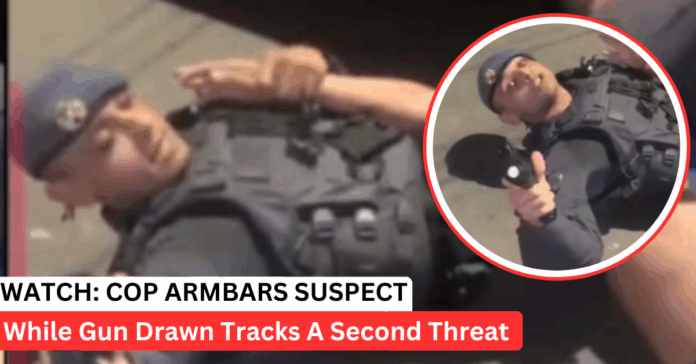

- A short clip shows a tense scene where a cop holds suspect in armbar while aiming a firearm at a second man.
- The moment highlights the promise and pitfalls of BJJ-style control in policing and de-escalation.
- Without full context, conclusions about policy or misconduct are risky.
- Training, distance management, and clear commands are the keys that decide whether techniques help or hurt.
What The Video Actually Shows
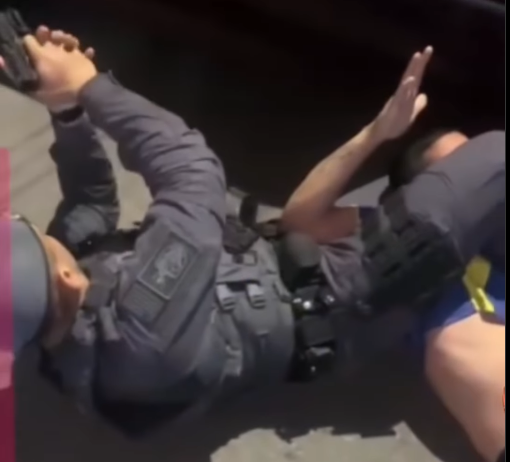
The footage racing around social media captures a high-stress snapshot in Brazil as a cop holds suspect in armbar on the pavement, keeping one arm isolated while directing his sidearm toward a second individual who steps in and out of the frame.
At face value, the image is jarring. It’s also a case study in how grappling intersects with law-enforcement tactics when multiple threats and unknowns collide.
Freeze the frame and you’ll spot the textbook mechanics—hips close, the suspect’s elbow controlled, shoulder line compromised. That’s precisely why the phrase cop holds suspect in armbar is trending: people recognize a BJJ staple being used under real pressure.
But the split second in which the officer has to both secure the position and assess a potential third-party threat is where the technique meets the realities of force-on-force decision-making.
Cop Holds Suspect In Armbar — A Viral Sensation
There’s a reason this specific clip landed in the algorithm’s sweet spot: it compresses fear, tactics, and debate into one image.

For supporters of grappling-based control, a cop holds suspect in armbar reads as a non-lethal, position-before-submission approach that can reduce strikes and chaos. Critics focus on the muzzle direction and the risk calculus: one hand is busy controlling the joint, the other is on a firearm, and a second person is moving nearby.
Both sides are reacting to what the camera doesn’t show—what preceded the takedown, what commands were issued, whether backup was incoming, and what the second man was actually doing.
Without that context, the cop holds suspect in armbar video becomes a Rorschach test: some see non-lethal restraint, others see risk.

The Promise And Pitfalls Of BJJ In Policing
BJJ-style control has been championed in departments precisely because it can create quick, high-percentage pins that end fights without baton strikes or prolonged scrums.
When a cop holds suspect in armbar correctly—controlling the elbow line, pinning the shoulder, keeping base—it can freeze a resisting subject long enough for cuffs or backup. That’s the promise.
The pitfall is the environment. Police encounters aren’t sterile mats: they have curbs, broken glass, tight spaces, and unpredictable third parties.
A cop holds someone in an armbar in a gym, and you hear a tap; same situation in the street, and you hear sirens, shouting, and tires rolling by.
The second man in the clip—regardless of intent—adds a dynamic problem. Even a “good” control can become a liability if the officer’s field of view, distance, and verbal management slip.
Where Training Meets Policy
If agencies want officers to use grappling, BJJ for law enforcement curricula have to extend beyond takedowns and joint control. Build scenarios where a cop holds suspect in armbar while a second role-player circles, shouts, or reaches in.
Layer in weapon retention, radio communication, and staged backup arrival. Teach fast transitions: abandon the armbar to turtle-ride, knee-ride to wrist control, or switch to a two-on-one if the second person closes distance.
Supervisors should audit body-cam footage for exactly these moments. If a cop holds suspect in an armbar and the scene expands, can the officer move, scan, and command? Those are trainable skills—just like finishing a traditional armbar on a resisting opponent is.
From Viral Clip To Useful Lesson
Strip away the noise and the lesson is clear: when a cop holds suspect in armbar in the wild, the technique is only as safe as the officer’s distance control, muzzle discipline, and ability to transition. The clip went viral because it’s dramatic; it should stick around in training rooms because it’s instructive.